

Ford Transit vs Mercedes Sprinter: Which Cargo Van is Best for Your Business?
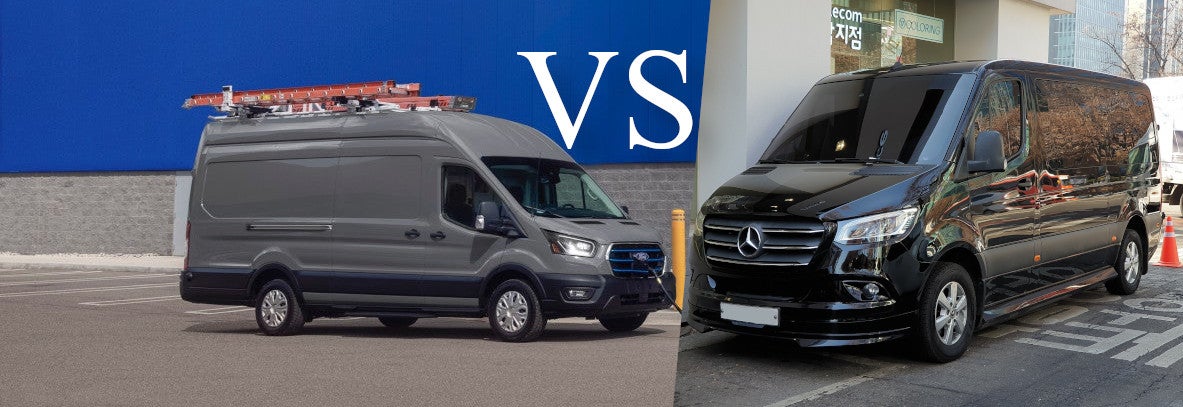 Used courtesy of Damian B Oh under the CC BY-SA 4.0 license.
Original location: https://commons.wikimedia.org/wiki/File:Mercedes-Benz_Sprinter_Tourer_VS30_Black_%281%29.jpg - Downloaded on 07/27/2026

For business owners, a cargo van may be the backbone of your business if you run a fleet of courier vans, or an invaluable asset for quick delivery of customer orders.
So when it's time to shop for your next cargo van, take some time to choose the one that best meets your business’s needs.
Business requirements
Buyers choosing a cargo van in the USA should consider factors such as their intended cargo payload and size requirements to ensure quick, easy loading.
When purchasing a cargo van, reliability, performance, dependable maintenance service and repairs, and spare parts availability should also be factored into any buying decision to avoid costly downtime.
Size matters: Ford Transit vs Mercedes-Benz Sprinter
To maximize loading capacity, buyers will obviously need to consider van size.
The Ford Transit can be configured to be tall enough for most crew members to stand comfortably inside while loading cargo, thanks to its availability in three roof heights, three body lengths, and four weight ratings that meet varying business requirements.
Buyers of the Ford Cargo Van can choose a 130-inch or 148-inch wheelbase, with respective lengths of 235.5 to 237.6 inches and 263.9 inches, plus an extended-length option on the longer wheelbase.
The 2026 Mercedes Sprinter van varies in size based on its wheelbase. The Sprinter is available with a 144- or 170-inch wheelbase and two roof heights: Standard or High, and, like the Ford, an extended-length option is available.
Height comparison
A higher roofline means not only increased cargo loading volume but also enhanced headroom, which is essential for improved productivity when loading or unloading your cargo van, without requiring the loading crew to keep their heads down to avoid injury.
Using the average height of a male in the USA, around 69 inches, it's easy to see which cargo van configuration from Ford and Mercedes will give your crew the best interior standing room.
The Transit is available with three roof height options:
- Low Roof Transit Van exterior height ranges from 82.4 inches to 82.9 inches with 56.9 inches of interior standing height
- Medium Roof Transit Van exterior height ranges from 99.1 inches to 101.3 inches tall, offering 72.0 inches of standing room
- High Roof Transit Van ranges from 109.6 inches to 110.4 inches on the exterior with an 81.5 inches of interior standing height
The Mercedes is offered in two roof heights:
- Standard Roof, with an overall exterior height of 96.3 to 98.4 inches and an interior standing height of 68 inches
- High Roof, which measures 107.3 to 108.7 inches on the exterior and offers 79.1 inches of standing height
A high roof does pose challenges when entering parking lots with height restrictions or delivery yards in parking garages. In contrast, a Low Roof Ford Transit Cargo Van will do well in tight clearances and urban parking spaces.
Interior cargo loading width
As important as interior standing height is, maximizing cargo volume and loading larger parcels is easier with a wider cargo area.
The Ford offers a maximum of 70 inches between the interior wall and 54.8 inches between the wheelhouses.
The interior of the Mercedes’s cargo area measures 70.4 inches and 53.1 inches between the wheelhouses.
Interior cargo loading length comparison
By now, we should have the picture that bigger is better for loading capacity, and that a longer interior simply offers more space.
The Transit Cargo Van with the 130-inch wheelbase has an interior length of 122.1 inches, while the 148-inch-wheelbase models offer 143.7 inches or, when shipped as an extended-length model, a generous 172.2 inches.
The Mercedes Sprinter’s interior measures 132.9 inches, with a 144-inch wheelbase, 178.2 inches on a 170-inch wheelbase, or 189.4 inches in the Extended version.
Cargo volume
Our table below gives you a quick comparison of the Ford Transit’s loading capacities vs those of the Mercedes Sprinter.
|
Ford Transit Low Roof short/long wheelbase |
Ford Transit Medium Roof long wheelbase |
Ford Transit High Roof long wheelbase/ Extended Length |
Mercedes Sprinter Standard short/long wheelbase |
Mercedes Sprinter High long wheelbase/Extended |
|
|
Volume ( cubic feet) |
246.7 / 277.7 |
357.1 |
404.3 / 487.3 |
319.0 |
488.0 / 533 |
Payload capacity comparison
The Ford Transit’s payload capacity does vary depending on your chosen vehicle configuration.
The maximum payload available on the 2026 Transit Van is 5,103 pounds when configured as a T-350HD High Roof with Extended Length, Rear Wheel Drive, and dual-rear-wheel configuration.
The Mercedes Sprinter payload capacity generally ranges between 2,800 pounds and 6,800 lbs, depending on the model, be it a 2500, 3500, or 4500, and whether it has a standard or extended wheelbase.
Ease of loading: Transit vs Sprinter
The Ford Transit's rear door opening width is 59.8 inches, standard across all roof heights, and is a 50/50 split design standard with a 180-degree opening, with a 253-degree swing-out option available on long-wheelbase variants.
The Sprinter Cargo Van has a standard dual rear door opening width of approximately 61 inches, with hinges that allow the doors to open up to 270 degrees, allowing them to latch against the sides of the van for easier loading and unloading at a loading dock.
Powertrain comparison
The Ford Transit is powered by a standard naturally aspirated 3.5-liter PFDi V6 delivering 275 horsepower with 260 pound-feet of torque, or an available 3.5-liter EcoBoost® V6 generating 310 horsepower and 400 pound-feet of torque.
Both powertrains feature a 10-speed SelectShift® automatic transmission and either Rear-Wheel Drive or Intelligent All-Wheel Drive.
Mercedes-Benz Sprinter cargo vans are exclusively powered by a 2.0-liter 4-cylinder turbocharged diesel engine, available in either Standard or High-Output configuration, making 168 horsepower with 295 pound-feet of torque, or 208 horsepower and 332 pound-feet of torque, respectively.
Standard is a 9G-TRONIC 9-speed automatic transmission, with rear-wheel drive or optional 4MATIC all-wheel drive.
Purchase the Ford Transit Cargo Van range at Best Ford Pro-Elite in Nashua, NH
Best Ford Pro-Elite in Nashua, NH, offers business owners professional services tailored to their real-world needs.
Be sure to contact our friendly and experienced sales team to discuss your Ford Transit Van commercial vehicle needs and allow us to get you the best Ford for your business.
Discover New Vehicles Today!